ResourcesFirst Things First
ProductivityPersonal Development
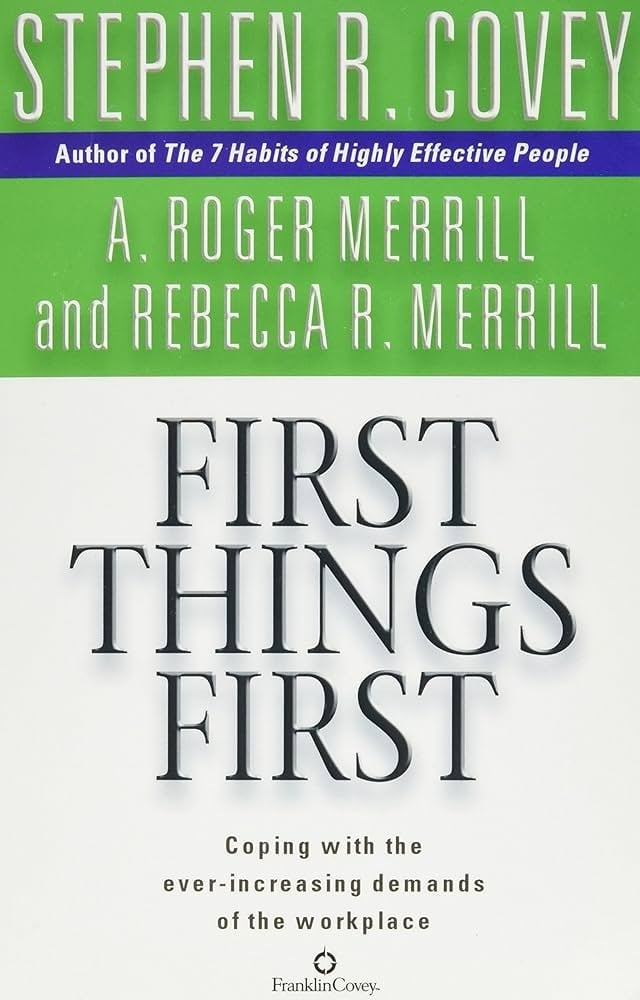
First Things First
by Stephen Covey
Stephen Covey explains setting goals as the most critical part of effective personal enhancement in his book First Things First. No matter how efficiently you do your work, it will have little impact if you are doing the wrong thing.
Shortcomings of Time Management
Covey explores time management through three generations of theory:
- Priority is what is happening now.
- Priorities are deducted from calendars and goals.
- Priorities derive from values and goals.
All three generations share a common flaw: they often ignore importance. You may manage your time well, yet still do meaningless things if you haven’t identified what truly matters.
Four Areas of Human Needs
- Physical needs: food, clothing, health.
- Social needs: caring for and maintaining relationships.
- Mental needs: learning and growth.
- Spiritual needs: contribution, purpose, and submission.
These four needs overlap, forming a 'fire inside' at the center where all needs converge. Focusing on one area often helps balance the others.
The Power of Prioritization
The key to prioritizing effectively is to review your previous actions and decide what actions are truly important next. Covey uses the metaphor of a gardener: just as a garden flourishes under care, our personal lives need active tending.
Placing Important Stuff First
Covey recommends focusing on what is important, not just urgent. The classic metaphor of a pot with rocks, gravel, sand, and water illustrates this:
- Major rocks: important non-urgent issues first.
- Gravel: relevant urgent matters next.
- Sand: urgent but less important items.
- Water: unimportant, non-urgent issues fill any remaining space.
Deciding What’s Important
One method is writing a personal mission statement containing:
- Recognition of your personal talents.
- A contribution to a purpose bigger than yourself.
- Review of your needs across the four dimensions: physical, mental, social, and spiritual.
Responding to Unplanned Situations
Life is unpredictable. Covey advises decision-making based on:
- Ask: Is this aligned with my personal goals?
- Listen to others to fully understand the problem.
- Be courageous and honest, even showing vulnerability when necessary.
By defining actions according to your personal mission statement and focusing on what’s most important, you can ensure your time is spent in the best possible way each week.