ResourcesSmarter Faster Better
Personal DevelopmentProductivity
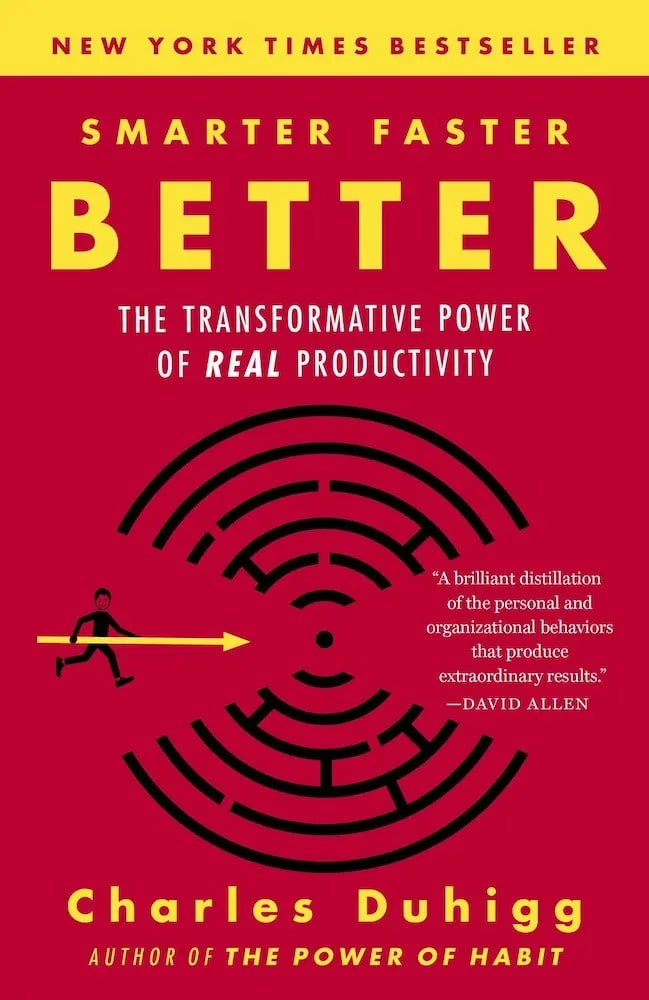
Smarter Faster Better: The Secrets of Being Productive in Life and Business
by Charles Duhigg
Nearly all of us have wondered what makes success tick, and if it is really possible to shape and see success in our minds before it happens. From New York Times bestseller and author of The Power of Habit, Charles Duhigg comes a book that attempts to guide you in the right direction.
Smarter Faster Better: The Secrets of Being Productive in Life and Business is a fascinating book that explores the science of productivity and why managing how you think is more important than what you think.
The research that went into the book is both academic and experience based. From studies in neuroscience, psychology, and behavioural economics to the decisions made by a diverse well of individuals ranging from FBI agents, Broadway songwriters to traditional CEOs, Duhigg outlines what it takes to be more successful and happier.
At the heart of it all is the ability to disregard the excess and focus on the important things. Or to sort out the wheat from the chaff. One of the conclusions drawn by the book is that people who rise above others and find success mentally picture the world and their place in it more vividly and exactly than others.
Some of the key concepts in productivity like motivation and goal setting to focus and decision making are used as springboards in the book to showcase success stories from the real world.
How Barack Obama’s choice of only grey or blue suits helped him in effective decision making. Or the world view of a PhD dropout who became one of the most successful players in the world. And how a sudden last minute sudden change of direction by the makers of the film Frozen made it into one of the highest growing films of all time.
What do these people have in common?
- They create pictures in their minds of what they expect to see.
- They tell themselves stories about what’s going on as it occurs.
- They narrate their own experiences within their heads.
- They are more likely to answer questions with anecdotes rather than simple responses.
- They say when they daydream, they’re often imagining future conversations.
- They visualize their days with more specificity than the rest of us do.
Some quotes from the book
- Productivity put simply, is the name we give our attempts to figure out the best uses of our energy, intellect, and time as we try to seize the most meaningful rewards with the least wasted effort.
- Motivation is more like a skill, akin to reading or writing that can be learned and honed.
- When people believe they are in control, they tend to work harder and push themselves more. Once people know how to make self-directed choices into a habit, motivation becomes more automatic.
- To teach ourselves to self-motivate more easily, we need to learn to see our choices not just as expressions of control but also as affirmations of our values and goals.
- Self-motivation flourishes when we realize that replying to an email or helping a coworker, on its own, might be relatively unimportant. But it is part of a bigger project that we believe in, that we want to achieve, that we have chosen to do.
- If you want to make yourself more sensitive to the small details in your work, cultivate a habit of imagining, as specifically as possible, what you expect to see before it appears.
- Numerous academic studies have examined the impact of stretch goals, and have consistently found that forcing people to commit to ambitious, seemingly out-of-reach objectives can spark outsized jumps in innovation and productivity.
- Stretch goals can spark remarkable innovations, but only when people have a system for breaking them into concrete plans.
- Many of our most important decisions are, in fact, attempts to forecast the future.
- Good decision making is contingent on a basic ability to envision what happens next.
- Making good choices relies on forecasting the future. Accurate forecasting requires exposing ourselves to as many successes and disappointments as possible.