ResourcesGive And Take
Personal DevelopmentStrategy & Innovation
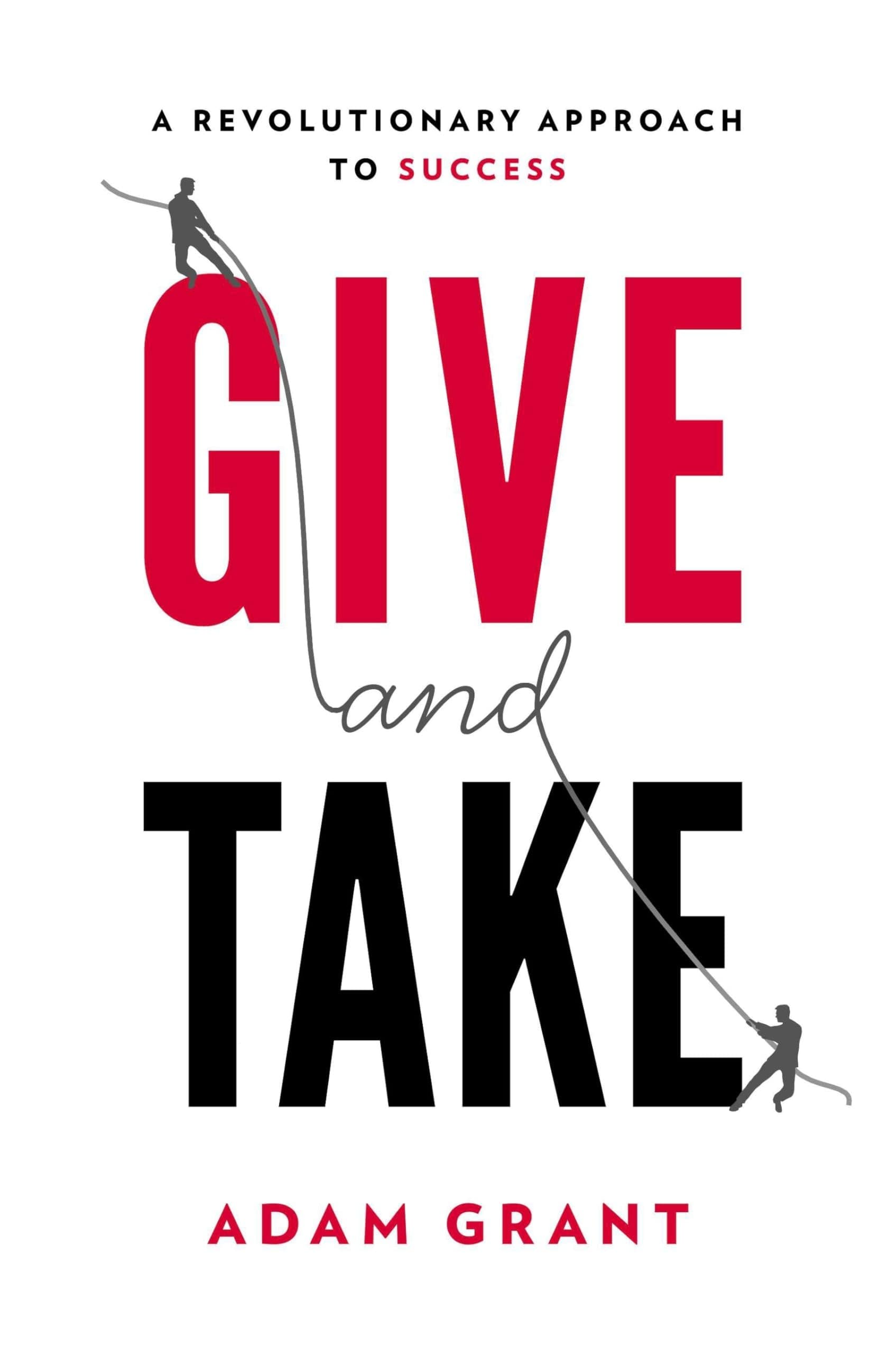
Give and Take : A Revolutionary Approach to Success
by Adam Grant
Pay it forward—the idea to give and create value before you expect to be compensated for your work—is a central premise of modern marketing. A parallel old school classic success principle is to do more than you’re paid for—in the vocabulary of commerce, to give more than you get—and in time you’ll be paid for more than you do. Another human relation 101 idea is to invest in the trust bank: Do good now, continue to do good over time, and eventually your virtue will be rewarded.
Samuel Johnson proclaimed, “The true measure of a man is how he treats someone who can do him absolutely no good.” Adam Grant’s Give and Take may be considered an exposition, amplification, and interpretation of Dr. Johnson’s wisdom.
Grant has earned his Bachelors from Harvard University and received his Masters and Ph.D. from the University of Michigan. He was recognised as the top-rated teacher at Wharton School of Business for five years in a row. He was also named among the world’s 25 most influential management thinkers, the top 40 business professors under 40, the 100 most creative people in business, Malcolm Gladwell’s favorite thinkers and HR’s most influential international thinkers.
For generations, we have focused on the individual drivers of success: passion, hard work, talent, and luck. But today, success is increasingly dependent on how we interact with others. It turns out that at work, most people operate as either takers, matchers, or givers. Whereas takers strive to get as much as possible from others and matchers aim to trade evenly, givers are the rare breed of people who contribute to others without expecting anything in return.
Grant proved that not only is taking bad for groups and society, but a worker with a taker mentality is also bad for any company’s growth. Leaders who are takers lead their teams to the ground in most cases, and normally end up shooting themselves in the foot in the long term. Regardless of what your ideas are about who is more successful (givers or takers or matchers), this book will help renew your confidence in effective leadership, its potential, and the future we are capable of creating.
Some quotes from the book
- The principle of reciprocity isn’t governed by self-interest.
- Adam Grant’s research revealed that in all professional environments there are people that act as either takers, givers or matchers. These interchangeable styles have a direct impact on why and how they succeed or fail. The book shows that takers are only interested in self-advancement, always assessing what others can offer them.
- Takers have a unique profile and are easy to spot. You can spot a taker from some distinctive features. They like to receive more than they give and abide by the “dog eat dog world” policy. They are altruistic in nature and like to self-promote their few good deeds so they can get recognition.
- The best leaders are givers. The most effective leaders prefer to give rather than take. Givers focus on what others need from them and endeavour to be generous with their time, knowledge, energy, skills, ideas and interactions with others. The least self-centred, boastful, and egotistical American president ever was Abraham Lincoln. He was a giver.
- Team work without a giving mentality will fall short. Grant noted that givers do poorly in medical school when every task was an individual activity. They normally soar in the second year when they become part of teams and began dealing with hospitals, nurses, and patients. A strong team with more givers will have access to a free flow of information, knowledge, expertise and connection.
- There’s a thin line between a giver and a doormat. Givers are always at the top of every success ladder and there are also some givers at the bottom. Those givers at the bottom did not know where to draw a line. To avoid being a doormat leader, Grant explained the necessity for givers to create boundaries around their giving to prevent burn-out.