ResourcesGrit: The Power of Passion and Perseverance
Personal DevelopmentProductivity
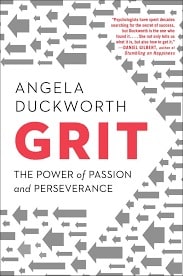
Grit: The Power of Passion and Perseverance
by Angela Duckworth
In this instant New York Times bestseller, pioneering psychologist Angela Duckworth shows anyone striving to succeed—be it parents, students, educators, athletes, or business people—that the secret to outstanding achievement is not talent but a special blend of passion and perseverance she calls “grit.”
Drawing on her own powerful story as the daughter of a scientist who frequently noted her lack of “genius,” Duckworth, now a celebrated researcher and professor, describes her early eye-opening stints in teaching, business consulting, and neuroscience, which led to the hypothesis that what really drives success is not “genius” but a unique combination of passion and long-term perseverance.
Passion means having enduring interest in the job you are doing. Perseverance means being persistent and never giving up. In the book, Duckworth shows how grit is important in understanding the psychology of achievement.
The book also discusses how talent gets overemphasised, whereas grit gets underemphasised. When we place more emphasis on talent, we ignore everything else, including effort. In a natural vs. striver situation, we are most likely to favour the naturally gifted person, thus leading to the naturalness bias. Duckworth argues that effort counts twice. A talent with no effort is just unmet potential. She shows that with the addition of effort, talent becomes skill, and skill when put to a productive use becomes achievement.
Growing Grit from the Inside Out
In order to help people cultivate a sense of passion and perseverance, the author introduces four psychological assets commonly found in the grittiest people: interest, practice, purpose, and hope. Interest and purpose are two sources of passion. Practice and hope help develop perseverance which nurtures the “never give up” attitude.
Interest: First one must have some interest in something, and that interest serves as the seed which over time, with practice and commitment, can grow into passion. Duckworth says, “Passion for your work is a little bit of discovery, followed by a lot of development, and then a lifetime of deepening.”
Practice: She emphasises not just quantity of time on task, but quality of time on task, and the importance of deliberate practice — reaching towards “stretch goals.” She makes the point that deliberate practice takes effort and is often uncomfortable — sometimes supremely effortful. She says that most “experts” can only handle 1 hour of deliberate practice before needing a break. She advocates studying the science of practice and offers suggestions.
A fascinating part of this chapter is where she contrasts deliberate practice, which she identifies with grit, with flow. Deliberate practice is carefully planned, and flow is spontaneous. Because deliberate practice requires working where challenges exceed skill, and flow is more commonly experienced when challenge and skill are in balance.
Purpose: After people find something they love to do and enjoy practicing it in order to develop their skill, most find that to stay motivated over time, they need a greater good that pursuing that interest serves. Most start out with a self-centred purpose (this feels good and is fun) to another-centred purpose (this activity can serve a greater good.) Purpose required a second revelation: “I personally can make a difference.”
Hope: She identifies two kinds of hope: (1) Hope without responsibility — a yearning for a sunnier tomorrow — where the onus is on God or the Universe to make things better. (2) Hope with responsibility — grit depends on the expectation/belief that our own efforts can improve our future. The Hope that gritty people have has nothing to do with luck and everything to do with getting up again.
She talks about suffering where we have no sense of control, which can lead to learned helplessness, and contrasts that with learned optimism. She gives examples of people who are taught a fixed, pessimistic, fatalistic view of life, versus those who are taught that they can overcome adversity with their own efforts. Her “paragons of grit” explain events and setbacks optimistically. Quite a bit of this chapter is about Carol Dweck and Growth Mindset and how attribution of success to effort rather than fate or talent are key qualities of grit.
Some Quotes from the Book
- I grew less and less convinced that talent was destiny and more and more intrigued by the returns generated by effort.
- There is a gap between potential and its actualization.
- Most of us become more conscientious, confident, caring, and calm with life experience.
- To do anything well, you have to overextend yourself. Necessity is the mother of adaptation.
- Interests are not discovered through introspection. Instead, interests are triggered by interaction with the outside world. And it thrive when there is a crew of encouraging supporters, including parents, teachers, coaches and peers.
- For the beginner, novelty is anything that hasn’t been encountered before. For the expert, novelty is nuance.
- Deliberate practice is behavior, and flow is an experience. Practice is for preparation, and flow is for performance. Hence, gritty people do more deliberate practice and experience more flow.
- There was a small but growing body of scientific evidence that happiness wasn’t just the consequence of performing well at work, it might also be an important cause.
- Following through on hard things teaches a young person powerful, transferable lessons.
- Without directly experiencing the connection between effort and reward, animals, whether they’re rats or people, default to laziness.
- To be gritty is to invest, day after week after year, in challenging practice. To be gritty is to fall down seven times, and rise eight.
- Enthusiasm is common. Endurance is rare. Rather than letting your interest be an intense burst of firecrackers, let it be a compass instead, guiding you on a long winding route to your ultimate goal.