ResourcesMatchmakers - The New Economics of Multisided Platforms
Marketing & SalesStrategy & Innovation
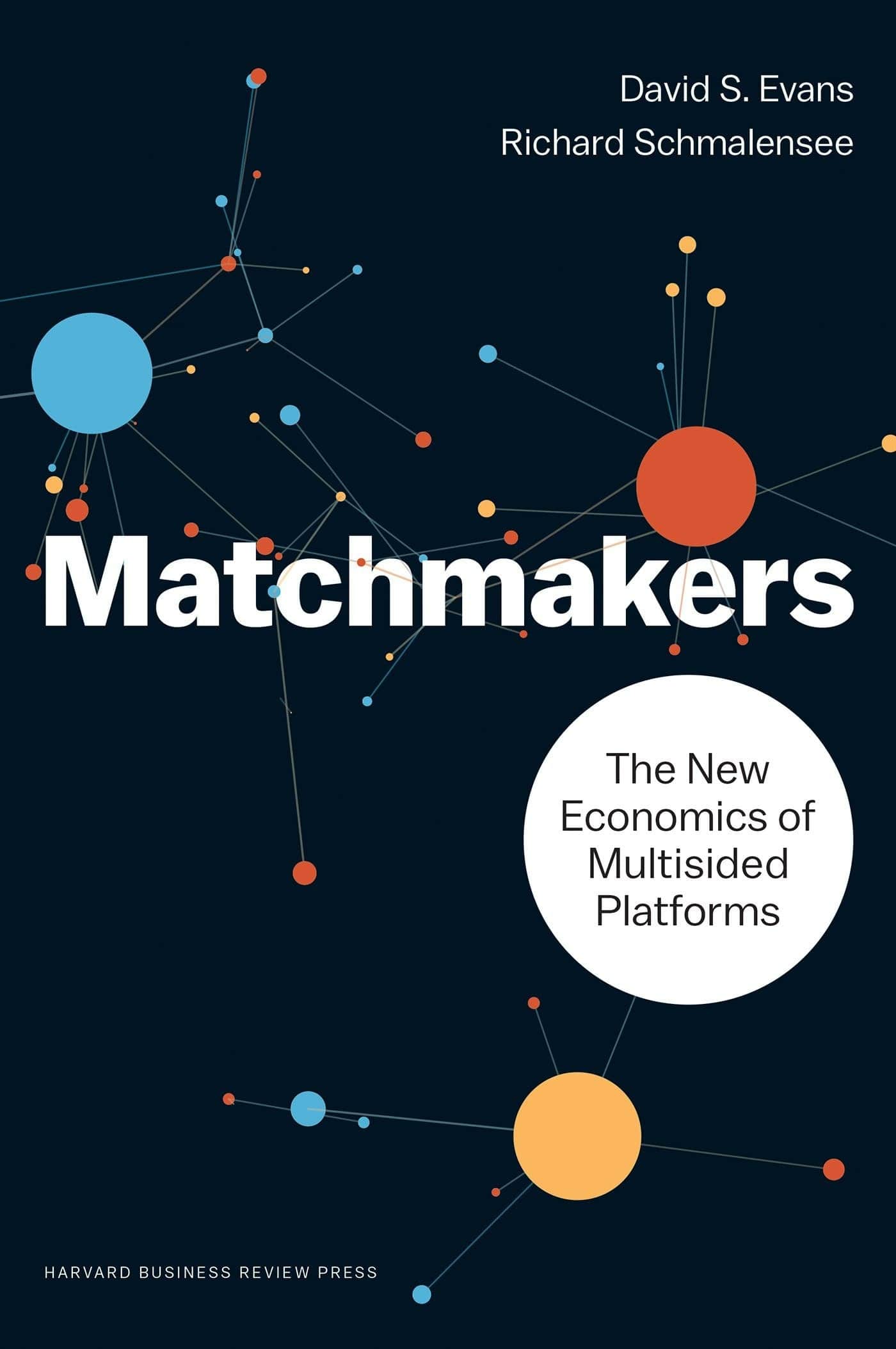
Matchmakers: The New Economics of Multisided Platforms
by David S. Evans, Richard Schmalensee
Sharing isn't new. Giving someone a ride, having a guest in your spare room, running errands for someone, helping to sell old stuff-- these are not revolutionary concepts. What is new, in the "sharing economy," is that you are not helping a friend for free. Rather you are providing these services to a stranger for money.
In this book, David Evans and Richard Schmalensee, two economists and experts on the sharing economy, explain the transition to what they describe as "crowd-based capitalism", a new way of organising economic activity that may supplant the traditional corporate-centred model.
Leveraged by modern technologies like high bandwidth data transfer, smart phones, online payment systems, data cloud, a lot of new companies have managed to crack the code of disruptive business and scaled up very fast.
The book looks at “multi-sided platforms” or platforms that generate all or most of their income by providing a value-added service to two or more groups of customers.
Examples of multi-sided platforms abound including Facebook, Uber, Airbnb, Alibaba, Google Play Store, YouTube, Amazon, PayPal. It is a two-sided instead of one-sided interaction. Here in Nepal also, we have disruptors like Hamrobazaar, Sastodeal, Foodmandu, eSewa to name a few.
It is a two-sided instead of a one-sided interaction.
Matchmakers is quick to point out that these businesses don’t follow the expected traditional business model. Unlike traditional businesses, multi-sided platforms often charge little or nothing to one group of customers on a permanent rather than temporary basis.
Multi-sided platforms also depend heavily on leveraging networks to achieve a critical mass of two groups of customers (often advertisers on one side and consumers on the other).
In most cases, users aren’t charged a dime to access a lot of services, yet these users provide income through advertising or transactions.
For example, a money-sending platform would charge more for sending money to a person who was not signed up than to a person who was signed up.
Whether you're an entrepreneur, an investor, a consumer, or an executive, your future will involve more and more multisided platforms, and Matchmakers--rich with stories from platform winners and losers—will help one to navigate this appealing but confusing world.
Some Quotes from the Book
- Multisided platforms must attract two or more types of customers by enabling them to interact on favourable terms. They may be physical or virtual in nature.
- With multisided platform businesses, there must be a sufficient number of participants on both sides that would benefit from getting together. To secure critical mass, companies may use a zigzag strategy, a two-step strategy, a commitment strategy, or a combination of these.
- Six technologies have helped drive innovation at matchmaking companies: more powerful chips, the Internet, the World Wide Web, broadband communications, programming languages and operating systems, and the Cloud.
- Business opportunities typically arise for multisided platforms when various types of friction or transaction cost prevent market participants from interacting easily and directly.
- The right pricing structure is critical for launching a multisided platform and ensuring it is profitable.
- The new economics of multisided platforms demonstrate that certain guidelines almost always apply, such as making markets thick, remembering that small can be beautiful, facilitating searching and matching, and balancing externalities.
- While turbocharged matchmakers will transform industries, the transformation will happen slowly over the course of many years, with some bursts of rapid change along the way.