ResourcesThe Innovator's Dilemma
Strategy & InnovationLeadership
The Innovator's Dilemma
by Clayton M. Christensen
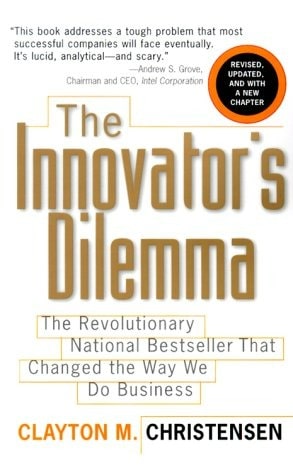
The Innovator's Dilemma, written by Clayton M. Christensen, a Harvard Business School professor is perhaps one of the most well-known books about business and innovation. It was published back in 1997, when the technology landscape was much different from today. However, as technology progresses faster than consumer demand, it is more relevant today than ever before to stay ahead.
At its core, the book describes how in spite of listening to their customers and having really good management, big companies find it difficult to navigate disruptive changes in their industry. In fact, the book argues that focussing too much on what your biggest customers have to say might lead you to miss out on disruptive technologies that invade your current market from below.
Sustaining Technologies vs Disruptive Technologies
Every product has a bunch of different axes along which customers grade them. Eg. A microprocessor can be graded on the basis of speed, power efficiency, software compatibility, cost, size, etc. In the case of sustaining innovation, companies keep making incremental improvements along the axes that their biggest customers care about at that point in time. Imagine a microprocessor company releasing increasingly faster chips every year because their customers want to produce increasingly faster computers. Big companies that listen to their biggest customers generally have no trouble maintaining their lead in the face of sustaining innovation.
Disruptive innovation on the other hand improves the product along a different axis (usually also accompanied by a reduction in price and complexity). These innovations often lead to products that are not immediately useful to a company's biggest customers. Many companies initially invest in them, but then give up on the technology as they don't see a good market for it. These disruptive technologies however can at times find its use in an entirely different untapped segment of the market, that was being ignored by the big company either due to its unfamiliarity or lower profit margin. Over time, these disruptive technologies can start invading the original lucrative market segment catching the big company off-guard.
Leading firms do not commit to disruptive technologies until it is too late, because of 2 key barriers to innovation:
- Value Networks: These are the contexts within which firms identify and respond to customers' needs, solve problems, secure resources, react to competitors and seek profits. A company's past experiences results in its perceptions and eventually resource-allocation decisions/patterns. Disruptive technologies usually start off as cheaper, simpler, combinations of off-the shelf components, and cannot serve the needs of mainstream markets. The new fringe consumers they create are initially unattractive to incumbents, but both the technology and markets evolve over time to directly threaten incumbents.
- Barriers to downward mobility: Established firms face 3 barriers to downward mobility: (a) characteristic cost structures, (b) resource allocation, and (c) upmarket movement of customers. These 3 factors create a pressure for leading firms to keep moving up-market, which in turn creates a vacuum in the lower-end markets to attract firms with lower cost structures and simpler technologies.
Putting it Together
Rather than provide a standard to-do list or checklist, Christensen used a detailed case study to illustrate a thinking process that can be useful across different contexts when addressing the problem of disruptive technological change. The key thinking process involves:
- Identifying potentially disruptive technology (Principle 5)
- Developing a flexible learning-focused strategy (Principle 3)
- Assessing the best commercial and team structure to execute this strategy (Principle 4)
- If appropriate, create an independent organisation (Principles 1 & 2). Create a different cost structure, start with a lean budget (to push the team to think out of the box and search for novel solutions), with a tolerance for failure so the new organisation can start the trial and error process.
The Innovator's Dilemma is an important and fascinating study on the relationship between organisational culture and the ability to innovate. New organisations innovate easier with disruptive technologies because they are not tied to outdated values or organisational norms. Overall, this book is a must read for anyone curious to understand how companies gain and lose market dominance over time.