ResourcesTo Sell is Human
Marketing & SalesPersonal Development
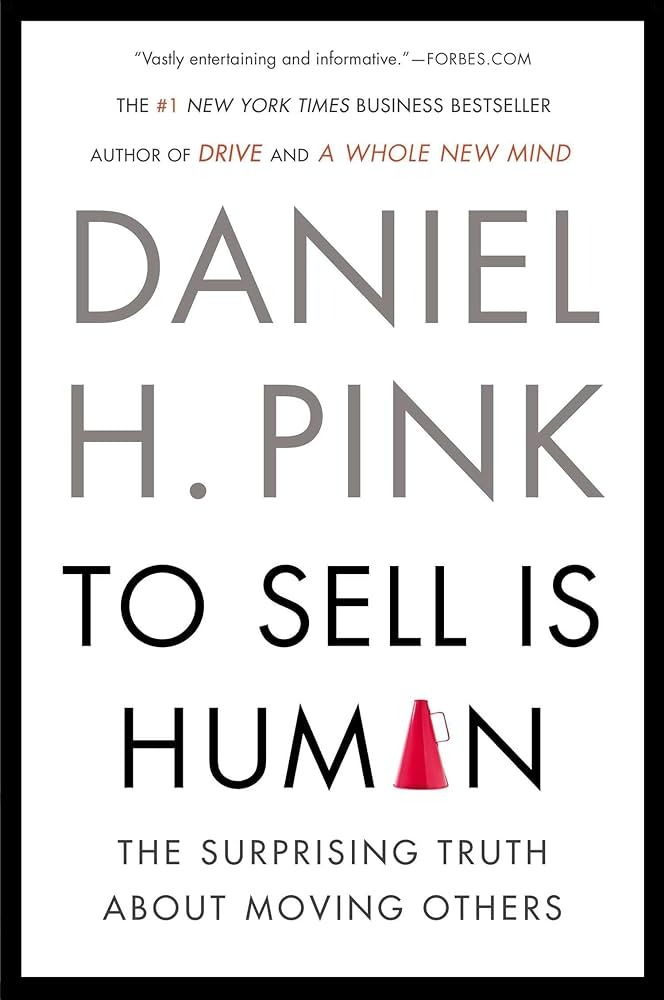
To Sell is Human : The Surprising Truth About Moving Others
by Daniel H. Pink
It’s something that courses through our veins. We do it for a purpose; we do it involuntarily. Every day each of us sells all kinds of stuff (thoughts, things, ideas) to others. Daniel Pink explains how in To Sell is Human. A behavioural expert with a background in politics and economics, Daniel H. Pink was a chief speech writer for then Vice President Al Gore. The book holds a list of accolades, being a number one New York Times, Wall Street Journal and Washington Post business best-seller.
We’re all in sales now. Sales has changed in the past 10 years: older door-to-door sales companies have gone out of business, and their practices seem outdated in a world where we can buy and research any product online. But still, 1 in 9 workers are in sales, and the rest of us are also selling—not just objects, but ideas and techniques. We are persuading, negotiating, and pitching, like lawyers selling juries on their verdict or public figures selling their personal brand on Twitter. In fact, a study Pink commissioned showed that people spend 40 percent of their work time selling something.
Pink writes, “To the smart set, sales is an endeavor that requires little intellectual throw weight – a task for slick glad-handers who skate through life on a shoeshine and a smile” – and deception, of course. But deception was only possible because buyers lacked information or expertise. Now, since buyers have reviews, ratings, and comparison shopping at their fingertips, sellers have more incentives to be fair and honest. It’s “seller beware.”
In the new world of sales, being able to ask the right questions is more valuable than producing the right answers. Here are six traits of successful sellers from the book:
Six Traits of Successful Sellers
- Attunement: Understanding the perspective of the buyer: assume that the buyer is the one with the power; focus on understanding the buyer’s thoughts rather than their feelings; mimic the buyer’s gestures.
- Buoyancy: The combination of “a gritty spirit and a sunny outlook.”
- Clarity: The ability to clarify what you’re offering, and why the buyer doesn’t want to buy.
- Pitch: The six new ways to pitch are: the one-word pitch, the question pitch, the rhyming pitch, the 140-character Twitter pitch, the subject line pitch, or the Pixar pitch (a six-sentence narrative structure used in Pixar movies).
- Improvise: Practice improvisation techniques if other methods don’t work.
- Service: Adopt an attitude of service. Believe in the value of the product and its impact on the buyer’s life.
Some Quotes from the Book
- We’re persuading, convincing, and influencing others to give up something they’ve got in exchange for what we’ve got.
- Honesty, fairness, and transparency are often the only viable path.
- What matters more today is problem finding.
- One of the most effective ways of moving others is to uncover challenges they may not know they have. Make it personal and make it purposeful.
- Non-sales selling is selling that doesn’t involve anyone making a purchase (and we’re all doing it, all the time).
- To sell well is to convince someone else to part with resources—not to deprive that person, but to leave them better off in the end.
- When buyers can know more than sellers, sellers are no longer protectors and purveyors of information. They’re curators and clarifiers—helping to make sense of the blizzard of facts, data, and options.
- Attunement, buoyancy, and clarity: these three qualities are the new requirements for effectively moving people in the twenty-first century.
- Attunement is the ability to bring one’s actions and outlook into harmony with other people and with the context you’re in.
- The ability to move people now depends on power’s inverse: understanding another person’s perspective, getting inside their head, and seeing the world through their eyes.
- Start your encounters assuming a position of lower power to better see the other side’s perspective.
- Synching mannerisms and vocal patterns to someone else helps both understand and be understood.
- Top performers are less gregarious than below-average ones; the most sociable salespeople are often the poorest performers.
- Ambiverts can balance inspecting and responding, key for any type of selling.
- Salespeople with an optimistic explanatory style—seeing rejections as temporary, specific, and external—perform better and last longer in their jobs.
- People derive much greater satisfaction from purchasing experiences than from purchasing goods.